


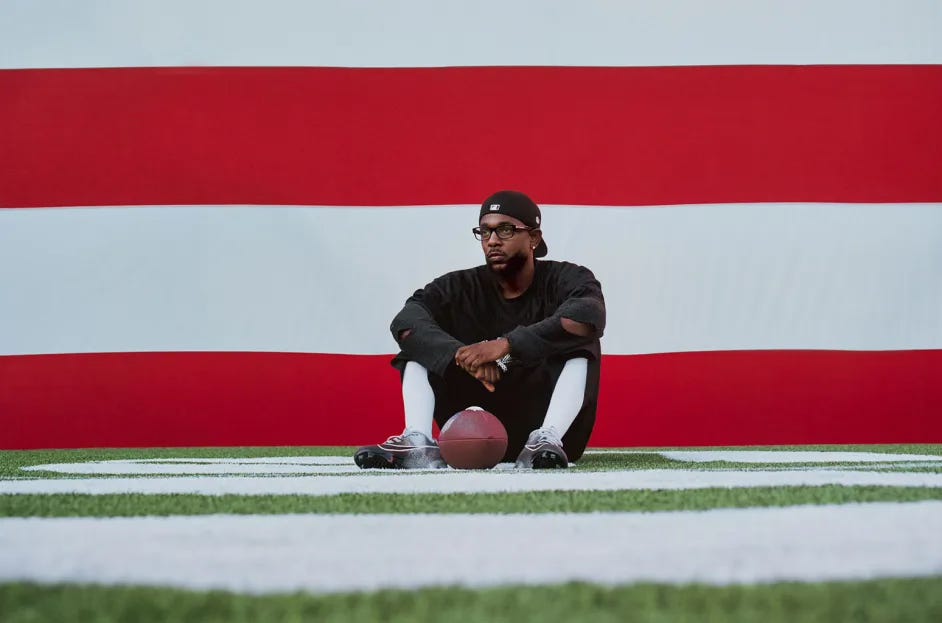
First off, I owe you all an apology for my recent ghosting—life just got a bit overwhelming, but I'm back, baby. And yes, I know I owe you a big culture catch-up (coming soon), but for now, let's talk Super Bowl LIX and—more importantly—the Apple Music Halftime Performance by Kendrick Lamar.
Let’s kick things off by saying I’m genuinely thankful that Trumper Mahomes and Kelce white liberalism failed on Sunday night. And failed spectacularly, at that. Embarrassing, truly. But let’s get something straight: I’m not an Eagles fan either; the Chiefs are just on my hate list. So, while the game was a bit of a snooze fest as the Eagles steamrolled their way to victory—shutting out the Chiefs in the first half—Kendrick Lamar took the opportunity to inject some much-needed excitement into the night.
Pulitzer Prize-winning Kendrick Lamar is a hitmaker and lyrical genius, and the performance was packed with some of his greatest tracks (I’ll forgive him for not calling up Beyoncé and getting permission for his part of the “AMERICA HAS A PROBLEM” remix). But it was more than just a musical showcase—it was a masterclass in the artistry of Kendrick Lamar. As a big fan (he’s literally one of like four or five men I actively listen to), it was exhilarating to watch his power unfold on that stage. And b before I dive into the performance itself, let me just say this: Kendrick Lamar is the greatest rapper alive, and "that's my opinion" (in Tamra Judge voice). I’m not entertaining any debates on this. Now, back to the show.
Alright, enough fanboying—let’s get into the performance itself. I’m not just going to give you a play-by-play rundown, though. I’m giving you the highlights of what stood out to me and the deeper meaning I pulled from it all:
Uncle Sam Jackson
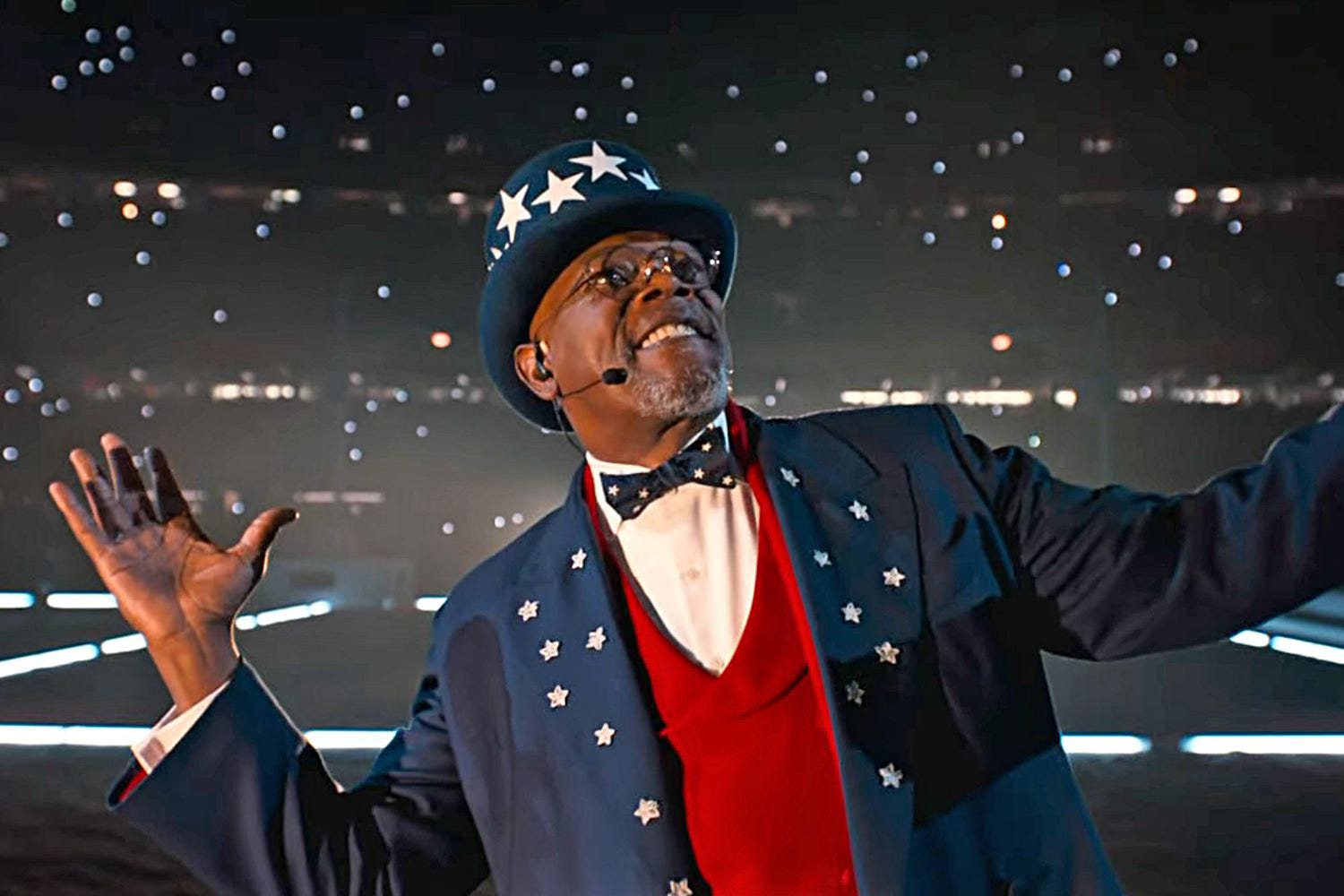
The show kicks off with none other than the legendary Samuel L. Jackson, decked out in a red, white, and blue suit, topped with a star-studded top hat, introducing Kendrick at “the Great American Game!” Jackson’s role is brilliant—a Black Uncle Sam flipping the typical image of patriotism on its head (which FOX News commentators were of course mad at forgetting that Uncle Sam is a fictional character to begin with). It's a commentary on who gets to be seen as patriotic in America, which is significant when you consider Jackson’s history, from being a fierce civil rights advocate to ushering at MLK Jr.’s funeral.
But it’s not just about flipping the narrative—it’s also a chance for Jackson to somewhat reprise one of his past roles from the critically acclaimed Django Unchained (2012). He doesn’t just play Uncle Sam, he plays Uncle Tom, pushing racial stereotypes often tied to hip-hop and Black Americans onto Kendrick. He injects his commentary throughout, calling Lamar loud, reckless, and “too ghetto.” When Jackson asks, “Do you really know how to play the game?” Is he talking about the game of football, or the game Black Americans are forced to play to seem palatable to mass audiences? Maybe both? I lean toward the latter. As the performance progresses, you start to see why.
Kendrick Takes Aim at Trump?
As Kendrick starts his set with an acapella, melodic rap sequence, he proclaims, “The revolution is about to be televised; you picked the right time but the wrong guy,” before transitioning into “squabble up” from his latest album GNX. While some may think this is a jab at a certain rapper, I see it as Lamar taking aim at a certain politician—and the current state of American politics.
That “revolution will be televised” line is a direct nod to Gil Scott-Heron's poem “The Revolution Will Not Be Televised”—which asserts that media will never show the violence of racism and that true change comes from individuals. Kendrick’s “wrong guy” line is his way of proclaiming that you will have no choice but to watch, no matter who you’re rooting for. With Donald Trump sitting right in the audience, Lamar’s message feels especially pointed. This isn't his first time taking shots at Trump, and it felt like a statement against other hip-hop artists who’ve been cozying up to him—looking at you, Snoop Dogg, Lil Wayne, and others.
The Divided States of America
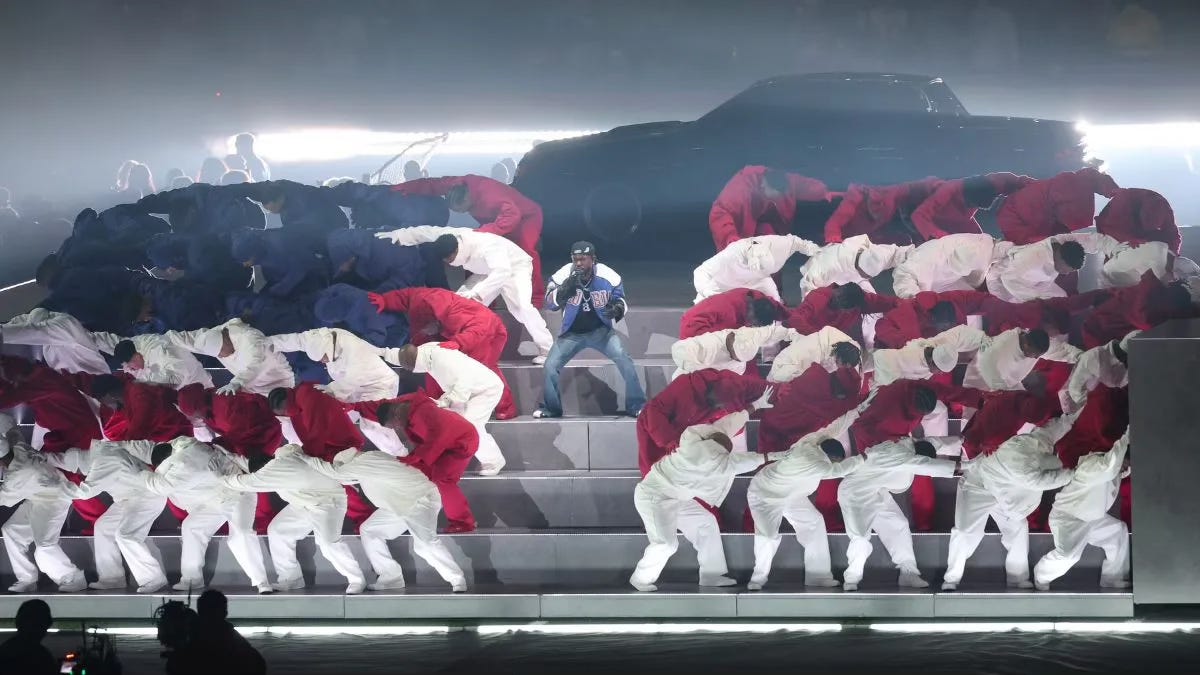
When Kendrick performs “HUMBLE.,” he’s flanked by dancers in red, white, and blue, forming the shape of the American flag. It’s during this moment that we get one of the most powerful visuals of the night. The dancers, split into two groups with their backs turned on each other, create a stark image of division. More than just symbolizing America’s flag, Kendrick is commenting on an America deeply divided, at odds with itself.
Kendrick Always Does It For the Culture
As Kendrick and his dancers navigate the stage, it becomes clear that they’re performing in a metaphorical prison yard. Lamar’s frequently rapped about the American carceral system and the injustice of mass incarceration against Black Americans, and this isn't the first time he’s highlighted these issues—remember his 2016 Grammys performance with the chain gang?
But Kendrick doesn’t stop there. Before jumping into “Not Like Us,” he drops a crucial line: “It’s a cultural divide” and follows it with “40 acres and a mule, this is bigger than the music.” For those who don’t know, 40 acres and a mule was the promised but unfulfilled reparations for Black Americans after slavery. Kendrick’s tying this back into the music world, notably taking a shot at Drake after he (inexplicably) said Kendrick raps like he’s “'bout to get the slaves freed”—as if that’s something to be ashamed of.
Drake Should Hide
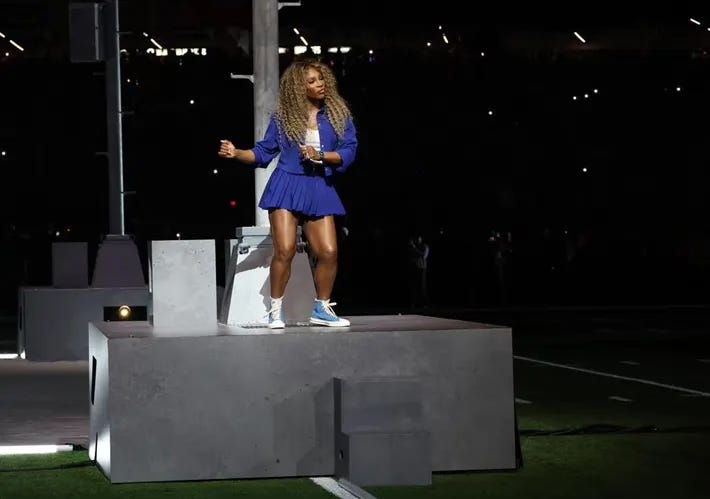
As Kendrick gears up for “Not Like Us”—which went viral and dominated the Grammys just a week prior—he brings out none other than the GOAT Serena Williams to crip walk along to the track. And the internet went wild. I had to double-check to make sure it was really her—what a monumental moment. But honestly, the most jaw-dropping part of the performance was hearing the entire stadium sing along to “A MINOR!” Kendrick’s shit-eating grin when he taunts “say Drake” had me cracking up.
If I were Drake, I’d go into hiding and never show my face again. The man’s got enough money to live off royalties forever, so just disappear, dude.
Bring Back the Flare
A total surprise was the internet’s fascination with Kendrick’s fashion choice: Flare jeans, baby. I’ve been rocking flare jeans for years, so seeing Kendrick sport them on stage was a personal win. But let’s be clear: boot cut is not the same as flare. It’s kind of funny watching men call it a boot cut because they’re homophobic brains can’t handle a typical masculine presenting man wearing something with some flare (I know low hanging fruit but I had to make the pun).
The Greatest of All Time
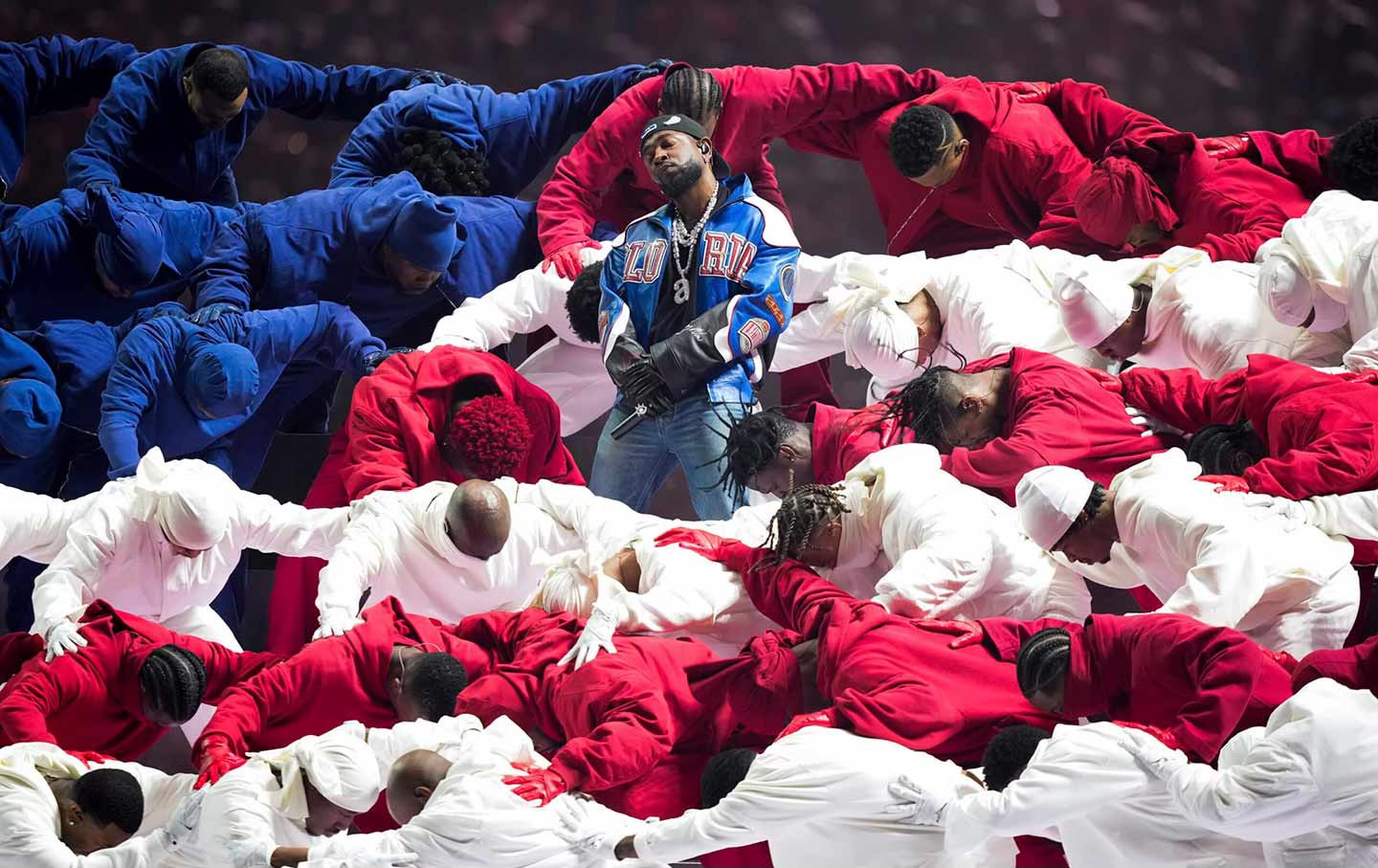
In the end, Kendrick Lamar didn’t just steal the show—he redefined it. Amidst a lackluster game and a performance dominated by safe choices from other halftime artists, Lamar used the spotlight to push boundaries, challenge narratives, and make a statement that transcended music. From flipping the script on patriotism with Samuel L. Jackson to throwing subtle jabs at politics and pop culture, Kendrick’s halftime show was more than just entertainment—it was a cultural moment. He didn’t just show up to rap; he showed up to remind us why he’s the greatest living rapper and why his voice remains one of the most important in the world today. If you missed it, well, you’ll just have to wait for the revolution to be televised—because Kendrick’s not waiting for anyone.
I was wondering about the Gil Scott-Heron thing. It seemed like an intentional reference but I'm not deeply embedded enough in rap culture to understand at the time if that was a Gil Scott-Heron reference or something else. Glad to see this interpretation.
I have a soft spot for Gil Scott-Heron because I wrote a small feature piece about him in a tiny free weekly in my university town back in the 1970s. I wish I had kept a clip of that sucker. Hell, I don't even remember the name of the little weekly I wrote it for. Nobody read the thing so the paper didn't stick around for long.
When I was watching Jackson, I was thinking that maybe one-tenth of the morons in maga would understand that he was mocking them. I wasn't sure at first, either. At first I was like, "oh, shit, did he (and Kendrick) go Snoop on us?"
I need to rewatch this show, partly because I wasn't as enamored as you were. I wanted more camera on the dancers and choreography. I felt like I was missing some "information" there. And I wanted more cussing. If the Super Bowl wants Kendrick, they should show all of him. Nobody does cussing better than Kendrick Lamar, and that's not sarcasm.
I also need to watch it again because Kendrick is a pretty complex individual. Listening to his lyrics requires a couple of listens if you don't want to miss something. It's like watching a good, but complex movie. I make it sound like I'm a big fan or expert. Not at all. I just remember seeing a thing or two of his and being impressed and loving the lyrics.
Thanks for this fantastic article on the show!